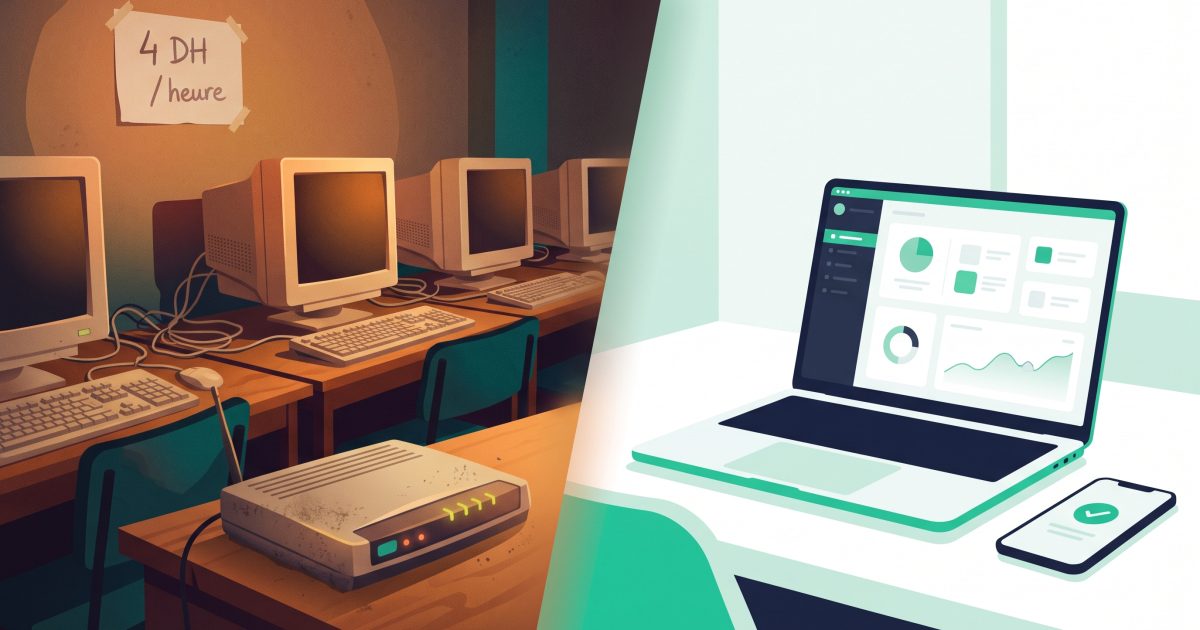
I grew up in Morocco when paying for software wasn’t just unusual; it was a genuinely funny idea. The internet lived in cybercafes, and access cost 4 dirhams an hour. That was the price of admission to the entire internet, unfiltered and unlimited for as long as your money lasted.
Then came the modem revolution. Suddenly you could get 24 hours of home internet for about 10 dirhams, roughly one euro. For me, that meant one thing: a download marathon. I’d spend that entire day grabbing every piece of software I could find. Malware or not didn’t factor into the decision. If there was a download button, I clicked it. The offline days that followed were for actually discovering what I’d collected.
The goal was never “which software should I buy.” It was “how do I get enough money for internet, so I can go collect more.” Friends and I traded burned CDs and USB sticks. Pirated software was the group’s currency. Even the operating systems preinstalled on used computers we bought secondhand were almost always pirated too.
By the time I reached high school, a company ran a Facebook ad for an online tutoring platform. It asked for 100 dirhams. Every time it showed up in our feed, we laughed. “Who’s dumb enough to pay for that?” That company went bankrupt not long after.
Then I moved to Europe for university, and something shifted. Torrenting is illegal in Germany, and I could finally afford to pay for things now. Paying for software stopped feeling foreign and became just how things work.
Looking back at that childhood through the lens of someone now considering building a SaaS product in Morocco, the old skepticism creeps back in. Has the mindset actually changed since I left? Services like Claude, Gemini, ChatGPT, and Spotify are clearly popular among Moroccans today. But popularity and willingness to pay are different things, and that tutoring startup shows what happens when you assume the second follows from the first.
I wanted actual numbers before answering that question for myself, not just nostalgia and gut feeling.
Why Nobody Paid, Backed by the Data
My childhood wasn’t an isolated anecdote. It matched the regional numbers. In 2001, Moroccan software piracy rates reached 61 percent, with businesses losing an estimated $5.5 million, while the global piracy rate stood around 40 percent. This wasn’t a Morocco-specific quirk either. By 2006, the Middle East and Africa region averaged a 60 percent piracy rate, with the UAE as the regional outlier at 35 percent. Morocco stayed stubbornly high for over a decade: a 2018 report comparing regional piracy rates still placed Morocco at 64 percent, worse than Egypt’s 59 percent.
But the piracy rate is really a symptom, not the disease. The actual bottleneck was that there was barely any internet to pay for in the first place. In 2004, Morocco’s internet subscription penetration was just 0.38 percent, and it took until 2007 to climb to 1.72 percent, with over 90 percent of that access running on ADSL broadband. When almost nobody has a fixed connection and even fewer have a bank card linked to anything digital, the question “would you pay for this SaaS” doesn’t even have room to be asked. There was no checkout page to abandon.
That 100 dirham tutoring startup wasn’t just badly received because Moroccans refused to pay for education. It was pitched cold, over Facebook ads, to a market with almost no established digital payment habits, no trust signals, and no cultural reference point for “subscribing” to anything online. It didn’t just have a pricing problem. It had a plumbing problem.
What’s Actually Different Now
This is the part that surprised me once I started digging, because the shift is bigger than I expected.
By the end of 2025, Morocco had reached 92.2 percent internet penetration, with 35.5 million users out of a population of roughly 37 million, and mobile internet accounts for over 93 percent of all connections, with mobile subscriptions alone exceeding 58 million against a population of 36 million. That’s not a gradual improvement from my cybercafe days. That’s an entirely different country from a connectivity standpoint.
The payment plumbing is catching up too, and fast. Morocco’s digital payments market is projected to grow from $14.29 billion in 2025 to over $35 billion by 2030, and the government’s National Financial Inclusion Strategy has set a formal target of bringing 75 percent of the adult population into the formal financial system by 2030. That target exists precisely because the starting point is rough: as of the most recent estimates, 56 percent of Moroccan adults remain unbanked, even with internet penetration above 90 percent. In Morocco, internet access and the ability to pay for things online are still two separate problems, and the second one is the harder one.
Investors have clearly noticed which problem is worth solving first. Moroccan startups raised $94.96 million in 2024, up sharply from $17 million in 2023, and the country climbed to 9th place in Africa on the 2025 Global Startup Ecosystem Index, a four-spot jump from the year before. But look at where that money actually went. In 2023, twenty Moroccan startups raised over $75 million in VC funding, and 80 percent of that total went to a single company, Cash Plus, a payments platform built for lower-income, often unbanked customers, backed by a $60 million investment from the IFC, Mediterrania Capital, and FMO. As of 2023, Morocco only had 47 fintech startups total, ranking it 7th in Africa, which tells you the space is still young. Still, the capital is chasing the exact bottleneck that killed businesses like that tutoring platform: how do you actually get money from a Moroccan customer to your company?
The Subscription Evidence Is Real, But It Has an Asterisk
Streaming gives us the clearest test case because it’s the closest analog to a consumer SaaS subscription, with years of regional data behind it.
Anghami, the dominant MENA streaming platform, reported 19.5 million active users in the first half of 2022, a 46 percent year-over-year increase, alongside 1.28 million monthly paying subscribers, up 41 percent. By early 2024, premium subscribers had grown to 1.87 million, up 18 percent year over year, with gross margin improving from 20 to 26 percent. International players noticed the opportunity too, with Spotify, Apple Music, and Deezer all entering the MENA region, and the regional music streaming market projected to grow at 9.5 percent annually, from $1.5 billion in 2019 to $3.2 billion by 2027.
So yes, people are paying. But run the ratio: roughly 1.9 million paying subscribers against nearly 20 million active users means the overwhelming majority of the region’s streaming audience still isn’t paying, even with a generous read of that gap. Freemium isn’t a stepping stone in this market; it’s the default state, with paid conversion still sitting in the low single digits of the user base. Anghami is the regional success story, and even it leans heavily on advertising revenue and free tiers, not subscriptions.
The AI Angle, Which Complicates the Optimistic Read
I brought up Claude, Gemini, and ChatGPT because they feel omnipresent among Moroccans I know. The global adoption data adds a useful reality check.
A 2025 study tracking generative AI traffic found that ChatGPT accounted for 77 percent of all traffic to the top 60 AI tools worldwide as of April 2025, up 113 percent year over year. But adoption isn’t evenly distributed. The same study found that 24 percent of internet users in high-income countries use ChatGPT, compared to just 5.8 percent in upper-middle-income countries and 4.7 percent in lower-middle-income countries, with GDP per capita strongly predicting the gap. The World Bank currently classifies Morocco as a lower-middle-income economy. That means the “everyone I know uses ChatGPT” feeling is very likely real within my own social and professional circle (students, young urban professionals, people in tech). Still, it isn’t representative of the national adoption rate, which sits meaningfully below what I’d see day-to-day in Germany.
That distinction matters a lot for a startup decision. “My peer group uses this constantly” and “there’s a broad market willing to pay for this” are not the same signal, and mistaking one for the other is close to exactly what happened to that tutoring startup: a product aimed at a segment that felt bigger from the inside than it actually was.
So Would My Startup Fail Like the Tutoring Company Did?
Not necessarily, but the honest answer is that it depends entirely on which Morocco I’m building for.
The tutoring startup failed at a moment when the underlying infrastructure genuinely wasn’t there yet: minimal internet penetration, no real digital payment habits, and a cold Facebook ad as the only trust-building mechanism for a market that had never been asked to subscribe to anything. Today’s Morocco has solved much of that problem. Connectivity is no longer the bottleneck. Payment infrastructure is being actively built, largely because investors have identified it as the most fundable opportunity. And there’s now a decade of regional subscription data (fintech, streaming, and increasingly AI tools) showing that paying customers exist.
What hasn’t changed as much is the size of that paying segment relative to the free or pirated alternative, and the price sensitivity of a lower-middle-income market. A consumer subscription product priced like a Western SaaS tool, marketed the way that tutoring startup was marketed, would likely struggle for similar reasons: the trust and payment friction the ad model can’t solve. A B2B tool sold to Moroccan businesses that already have budgets, bank accounts, and a reason to pay for reliability, or a low-ticket, mobile-money-integrated product priced for the local market rather than an imported price tag, is answering a fundamentally different question than “will Moroccans pay for software,” and the data is considerably more encouraging for that version of the question.
My own shift, from someone who saw a download button as an invitation, to someone who now pays without thinking twice, wasn’t really about my values changing. It was about the infrastructure and the incentives around me changing first. Morocco is partway through that same shift, unevenly, starting from a lower-income base, but moving in the same direction. Whether my startup lands on the right side of that gap probably matters more than whether the country’s mindset has “changed” in some general sense. It hasn’t changed uniformly. It’s changed for specific segments, price points, and payment rails, and that’s what’s worth designing around.